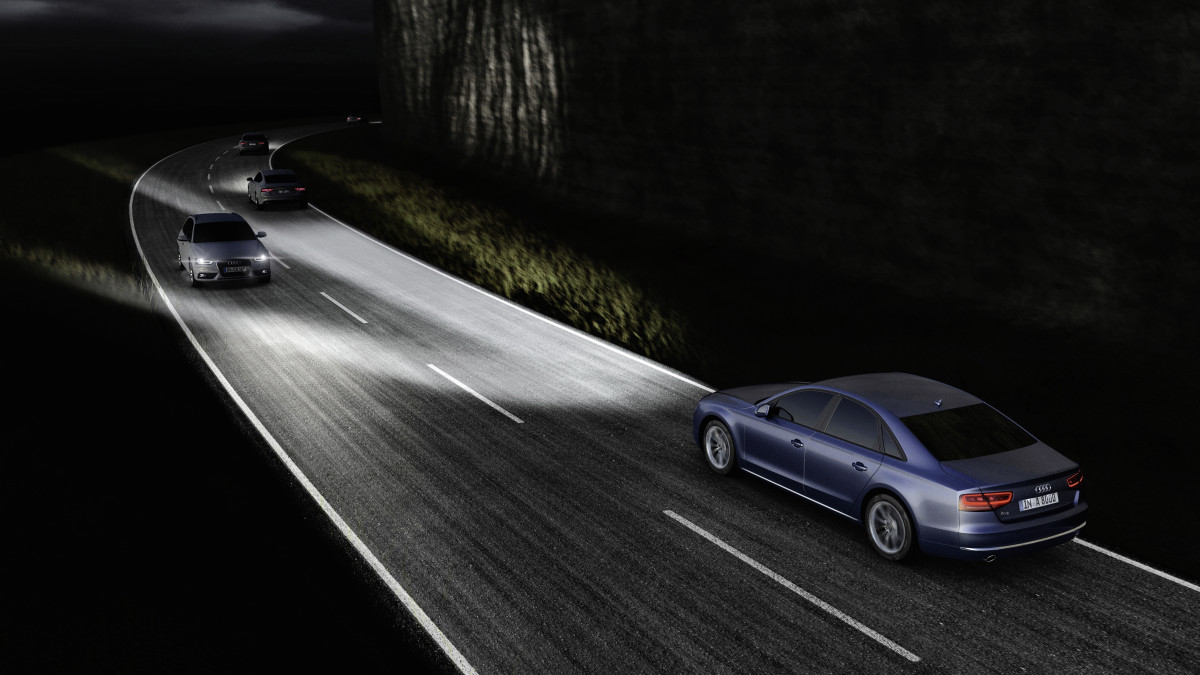
Over in Europe and in Canada, some automakers offer fancy LED headlights that can selectively dim sections of the light to prevent glare while maintaining long-distance illumination elsewhere. And according to testing by AAA, these lights don't just sound good on paper, they offer greater illumination and potential for reduced glare over U.S.-spec lights.
In testing, the organization found that the adaptive lights provided 12.5 percent more high-beam illumination than the U.S. versions. In low-beam mode, U.S. lights were better by just 1.9 percent. But the big advantage is running high-beams even with nearby cars, and AAA says that comparing U.S. low beams with the adaptive headlights running in normal high-beam mode, the adaptive lights can illuminate 86 percent more area ahead of the car. Perceived glare from all lights were in the low range, and when going over hills, the adaptive lights usually caused less glare than U.S.-spec lights, though occasionally the adaptive lights were slow to adjust over hills.
So why don't we have these lights available? The Federal Motor Vehicle Safety Standards (FMVSS) code doesn't allow for low-beams and high-beams to be active simultaneously, which is required for adaptive lights to work. In addition, the government uses static tests for lights with brightness limits for low- and high-beams. Because adaptive lights only dim select areas, the overall brightness will be too high.
Considering the benefits of adaptive lights, it's no surprise that AAA feels that the government needs to change the regulations to allow them. AAA isn't the only group pushing for European-style lighting standards, either, as Toyota, VW and BMW petitioned the government for revisions, and NHTSA is developing regulations that allow the lights. AAA supports NHTSA's move to permit adaptive headlights. It also has its own suggested changes such as more dynamic testing, including road tests. Additionally, AAA proposes upping the high-beam output limit from 150,000 candela to the European 430,000 candela, provided that the lights can start adjusting at the 400-meter mark Europe tests the lights at rather than the U.S. 220-meter mark. The organization notes that the higher light power is a contributing factor to the European lights' better illumination.